The Vietnam ecommerce market is still growing quickly in 2026, but growth is no longer the most important story.
The bigger change is concentration. Shopee and TikTok Shop now control almost the entire major marketplace economy; fewer sellers are capturing a larger share of GMV, social content is moving closer to checkout, and new ecommerce regulations are increasing the operational requirements for platforms and sellers.
For foreign brands, that changes the market-entry question.
It is no longer enough to ask whether ecommerce in Vietnam is growing or which marketplace has the largest audience. Brands need to understand where customers discover products, how platform economics affect margin, when livestream and creator commerce matter, and whether a marketplace-first, DTC-first, or hybrid model makes more sense.
This guide looks at the most important Vietnam ecommerce trends in 2026, the changing Shopee and TikTok Shop landscape, new legal requirements, and what these developments mean for international brands considering the market.
The Vietnam Ecommerce Market Is Growing, but It Is Also Consolidating
The headline numbers remain strong.
According to YouNet ECI data cited by Cimigo, Shopee, TikTok Shop, Lazada, and Tiki generated approximately VND 264.8 trillion in GMV during the first half of 2026. Shopee accounted for 54.5%, while TikTok Shop reached 43.4%. Together, the two platforms represented almost 98% of measured marketplace GMV.
That is a significant shift from 2025.
Momentum Works estimated Shopee at 58% of Vietnam’s multi-category marketplace GMV in 2025 and TikTok Shop at 39%. A year earlier, their shares had been approximately 65% and 28%.
The direction is clear:
Vietnam is increasingly becoming a two-platform marketplace.
But the more interesting signal is what is happening to sellers.
Cimigo’s summary of YouNet ECI data reported that the number of revenue-generating non-mall shops fell by roughly 27% year over year in H1 2026, while average GMV per active seller increased substantially.
So Vietnam e-commerce growth does not mean every seller is growing.
The market is getting bigger, but value is becoming more concentrated.
For foreign brands, simply opening a store is becoming less of an advantage. Execution, brand trust, content, conversion, logistics, and economics matter more.
Shopee vs TikTok Shop Vietnam Is Really Search Commerce vs Discovery Commerce
The most useful way to compare Shopee vs TikTok Shop Vietnam is not only through market share.
Their strongest consumer behaviors are different.
| Platform | Primary Strength | Typical Consumer Behavior | Best Fit |
| Shopee | Search, comparison, marketplace depth | Shoppers often arrive with category or product intent | Established demand, broad catalogues, price comparison |
| TikTok Shop | Discovery, creators, video commerce | Content can create demand before the customer searches | Demonstrable products, beauty, fashion, lifestyle, impulse-led categories |
| Lazada | Conventional marketplace commerce | Search, brand stores, promotions | Selected established brands and existing marketplace audiences |
| DTC Website | Brand ownership and customer data | Higher-intent branded journey | Retention, premium positioning, CRM, owned customer relationships |
Shopee remains larger, but TikTok Shop’s growth shows how quickly discovery and commerce are converging. This should not automatically lead brands to choose TikTok Shop. The decision depends on the category.
If consumers already know exactly what they want and compare specifications, sellers, ratings, and prices, Shopee can be extremely important.
If the product benefits from demonstration, creator recommendation, transformation, storytelling, or impulse discovery, TikTok Shop may play a larger role.
Many brands will need both.
Live Commerce Is Becoming Part of the Conversion Infrastructure
Live commerce in Vietnam should not be treated as a temporary entertainment trend.
Livestream shopping combines several activities that conventional ecommerce separates:
- product demonstration
- sales explanation
- audience questions
- creator endorsement
- promotions
- urgency
- checkout
That can shorten the distance between consideration and purchase.
TikTok Shop has made this particularly visible, but livestream commerce also exists across other platforms and seller ecosystems.
The strategic value is category-dependent.
Livestream can work well when consumers have questions that can be answered quickly, when products need demonstration, or when promotions influence purchase timing.
Beauty, fashion, household products, food, accessories, and other visually demonstrable categories can fit naturally.
For higher-consideration products, livestream may play more of an education or lead-generation role than an immediate conversion role.
The mistake is assuming every brand needs a livestream operation.
A premium brand that depends heavily on controlled positioning may need a different format from a low-consideration product competing around deals and volume.
Vietnam Ecommerce Is Moving From Traffic Competition to Operating Competition
One of the more important Vietnam ecommerce trends in 2026 is that acquiring marketplace traffic is no longer the whole problem.
Seller economics are becoming harder. A seller needs to account for:
- platform commissions
- transaction fees
- advertising
- affiliate commissions
- vouchers
- shipping subsidies
- returns
- creator fees
- fulfillment
- customer service
- taxes
- cost of goods
A campaign can produce impressive GMV and still have weak contribution margin. Foreign brands should therefore model economics before assuming marketplace scale is attractive.

Price Matters, but Trust Is Becoming More Important
Vietnam is often described simply as a price-sensitive market. That is incomplete.
Recent market data also points toward stronger spending on higher-value products and growing performance from official brand stores. That suggests an important shift in Vietnam consumer behavior.
Customers still care about promotions, but authenticity, seller credibility, reviews, and product quality can also influence purchase decisions.
This creates room for foreign brands that cannot win purely through discounting.
Their advantage may instead come from:
- product authenticity
- official distribution
- warranties
- certifications
- quality
- differentiated formulation or technology
- strong customer support
- trusted creators
- clear product education
The role of localization is therefore not always to make a foreign brand look local. Sometimes it is to explain why the foreign brand is worth choosing.
Cross-Border Ecommerce Is Becoming More Structured
Cross-border ecommerce in Vietnam remains commercially attractive, but regulatory obligations are increasing.
Vietnam’s new Law on E-Commerce, Law No. 122/2025/QH15, took effect on July 1, 2026. The Government also issued Decree No. 248/2026/ND-CP to implement parts of the law.
The framework applies to domestic and foreign organizations and individuals participating in e-commerce activities in Vietnam. It also contains dedicated provisions for e-commerce involving foreign elements.
Depending on how a foreign platform or seller operates in Vietnam, requirements may involve areas such as:
- seller identification
- legal representation
- product information
- consumer protection
- transaction records
- complaints
- livestream activity
- affiliate marketing
- data-related obligations
The exact requirements depend on the business model.
Foreign brands should therefore treat legal structure, product eligibility, tax, fulfillment, and marketplace registration as part of the market-entry strategy rather than issues to solve after marketing begins.
The 2026 Ecommerce Law Also Changes Creator Commerce
The Vietnam ecommerce law 2026 is especially relevant because ecommerce now overlaps heavily with social content.
The Ministry of Industry and Trade notes that the new framework introduces obligations around seller identity verification and places clearer responsibilities on ecommerce platforms.
It also directly addresses livestream sellers and affiliate marketers.
Individuals conducting livestream sales, including KOLs, KOCs, influencers, and hired sellers, must verify their identities. Product presentations must not mislead consumers about quality, origin, price, warranty, or availability. Affiliate activities must also provide transparency around roles, referral links, and codes.
For brands, compliance can no longer sit only with the legal department.
It needs to enter:
- creator briefs
- affiliate contracts
- product claims
- livestream scripts
- approval workflows
- marketplace operations
Creator commerce is becoming more formalized as it scales.
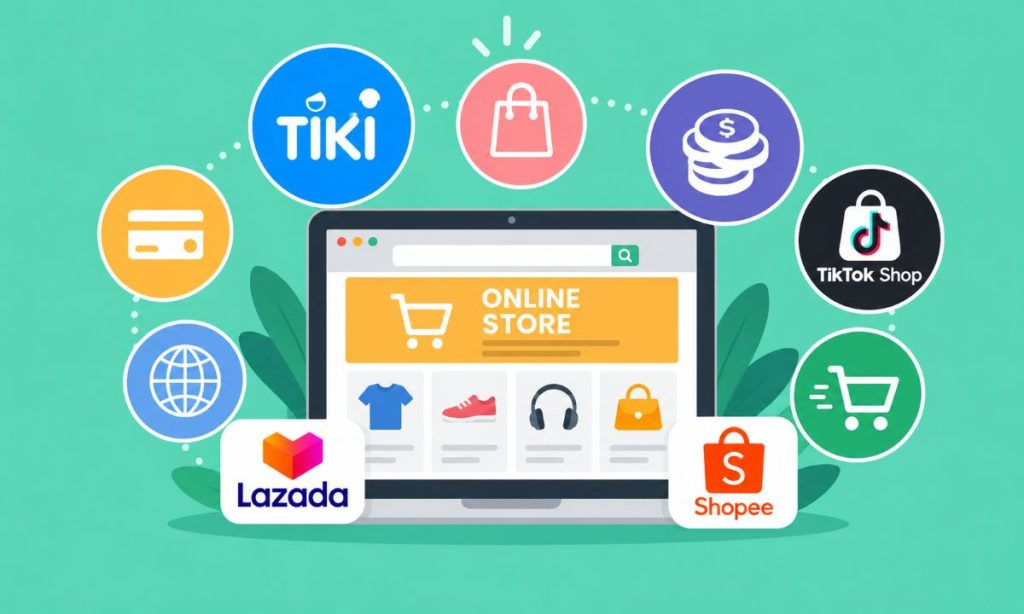
DTC Brands Should Not Assume Marketplace-First Is Always Best
For DTC brands in Vietnam, marketplaces offer obvious benefits.They provide traffic, payments, fulfillment infrastructure, consumer trust, and an existing shopping environment. But marketplaces also create dependency.
The seller does not fully control:
- customer data
- platform fees
- ranking algorithms
- promotional expectations
- acquisition costs
- competitor proximity
An owned website provides more control over brand experience, data, CRM, and retention, but generating demand independently can be much more expensive.
The better question for ecommerce market entry in Vietnam is often not marketplace or DTC.
It is:
What should each channel own?
For many international brands, a hybrid model may make more sense.
TikTok and creators can create demand.
Shopee or TikTok Shop can reduce first-purchase friction.
The DTC website can support deeper education, premium brand experience, CRM, and repeat purchasing.
The exact structure depends on category economics and consumer behavior.
What Foreign Brands Should Test Before Scaling
Before committing significant budget to the Vietnam ecommerce market, we would usually validate five areas.
Product-Market Fit
Determine which products have the clearest local demand rather than launching the full catalogue.
Value Proposition
Test how Vietnamese customers understand the benefit, what objections come up, and whether the price needs additional justification.
Platform Role
Determine whether Shopee, TikTok Shop, DTC, or a combination best matches the purchase journey.
Acquisition Model
Test creators, affiliate commerce, paid media, search, livestream, and organic content separately enough to understand what drives performance.
Unit Economics
Measure margin after platform fees, advertising, promotions, creators, shipping, returns, and operational costs.
The objective is not maximum GMV during the launch phase.
The goal is to identify a model that can scale without destroying margin.
Frequently Asked Questions
1. What are the biggest ecommerce platforms in Vietnam?
Shopee and TikTok Shop are currently the two dominant ecommerce platforms in Vietnam. Shopee remains the largest marketplace, while TikTok Shop has gained market share rapidly by combining short-form content, creators, livestream shopping, affiliate commerce, and in-app checkout. Lazada remains present but operates at a much smaller scale than the two market leaders.
2. Is Shopee or TikTok Shop better for selling in Vietnam?
It depends on how customers discover and evaluate the product. Shopee is usually stronger when shoppers already have category or product intent and want to compare prices, sellers, and reviews. TikTok Shop can be more effective when discovery, creator content, demonstrations, and impulse purchasing play a larger role. Many brands may benefit from using both for different stages of the customer journey.
3. What are the main e-commerce trends in Vietnam in 2026?
The major trends include the continued rise of TikTok Shop, greater concentration around Shopee and TikTok Shop, livestream and creator-led commerce, stronger performance from official brand stores, increasing pressure on seller margins, and more formal regulation of platforms, livestream sellers, and affiliate marketing. Mobile-first shopping and social discovery also continue to shape Vietnam consumer behavior.
4. Can foreign companies sell online in Vietnam?
Yes, but the appropriate structure depends on the platform, product category, and whether the company is selling locally or cross-border. Foreign brands may need to consider business registration, tax, product compliance, marketplace eligibility, fulfillment, consumer protection, and local representation requirements. Brands should clarify these issues before investing heavily in customer acquisition.
So, What Does the Vietnam Ecommerce Market in 2026 Mean for Foreign Brands?
The Vietnam ecommerce market remains attractive, but entering it is becoming more demanding.
Shopee and TikTok Shop are consolidating marketplace power. Creator content and livestream shopping are moving product discovery closer to purchase. Platform fees are squeezing seller margins. Consumers have more choice, while the new ecommerce law is creating clearer obligations for platforms, sellers, livestream hosts, and affiliate marketers.
For foreign brands, that means the winning strategy is unlikely to be simply listing products on every major platform.
The better approach is to decide where discovery should happen, where the first transaction should happen, how trust will be created, and which channel should own the customer relationship after purchase.
Then test the economics before scaling.
For international brands evaluating a broader Vietnam market entry, AM Digital can help connect ecommerce strategy with localization, paid acquisition, creators, platform selection, and go-to-market execution through our Vietnam Market Entry services.